TLDR
The best label material for outdoor equipment is usually laminated permanent vinyl for visible decals on smooth or gently curved surfaces, or industrial polyester/PET with permanent acrylic adhesive for serial numbers, barcodes, warnings, and long-life identification on compatible flat surfaces. Do not choose on face material alone. The adhesive, overlaminate, printing system, equipment surface, cleaning routine, application temperature, and exposure orientation all affect service life.
For most general-purpose equipment graphics, start with a laminated vinyl construction and request samples for the actual surface. Move toward a documented industrial polyester system when dimensional stability, abrasion resistance, chemical contact, or long-term barcode readability matters more than conformability. If the equipment uses textured plastic, powder coat, HDPE, polypropylene, or a rubberized housing, require an on-equipment adhesion test before ordering a production run.
Laminated vinyl or polyester: the practical choice
Vinyl is the more forgiving starting point for branding, operating instructions, ownership markings, and other graphics that need to follow mild curves. A compatible laminate protects the printed surface from weather, handling, and routine cleaning. Commercial constructions vary, however. One current outdoor product is described as white vinyl with permanent adhesive and laminate, with a manufacturer-stated outdoor life of five years; that claim does not establish suitability for immersion, pressure washing, aggressive chemicals, or difficult plastics. When that general construction fits the job, custom laminated vinyl decals are a direct ordering option.
Industrial polyester, also called PET, is usually the stronger direction for flatter identification panels, serial labels, rating information, and machine-readable codes. Polyester tends to hold its shape well, but the precise performance belongs to the complete manufacturer-qualified construction. Brady, for example, identifies its B-8591 product as polyester with permanent acrylic adhesive for high-surface-energy surfaces. Brady states resistance to UV exposure, abrasion, and fluids, lists an in-service range of -94°F to 356°F, and publishes 12-plus-year outdoor durability. The supplied product information does not define the exposure location, orientation, printing configuration, or cleaning cycles behind that durability statement, so it should not be treated as a universal result. Review Brady’s B-8591 product specifications for the stated construction and limitations.
| Material direction | Best fit | Main advantage | Important limitation |
|---|---|---|---|
| Laminated permanent vinyl | Visible decals, instructions, logos, and gently curved panels | Conformability and broad graphic options | Service life depends on the film, adhesive, ink, laminate, surface, and exposure |
| Industrial polyester/PET | Serial, barcode, warning, rating, and asset labels on compatible flatter surfaces | Dimensional stability and availability in documented industrial systems | Can be less suitable for compound curves; adhesive must match the substrate |
| BOPP or polypropylene film | Only when a specific product data sheet supports the outdoor application | May suit certain packaging or moisture-resistant applications | The material name alone does not establish outdoor durability or equipment-surface adhesion |
| Paper | Temporary indoor or protected identification | Low cost and easy printing | Not a responsible default for exposed outdoor equipment without a purpose-built, documented construction |
The useful distinction is therefore not “vinyl is waterproof” versus “polyester is industrial.” Those descriptions are too broad. Compare named products, including their adhesive and protective layer, under conditions that resemble the intended installation.
What determines the best label material for outdoor equipment?
Sunlight and exposure orientation
Direct sunlight can affect the face film, printed color, adhesive, and laminate. Horizontal or upward-facing labels are generally a harsher assignment than labels mounted vertically because they receive more direct exposure and can retain water or contamination. Ask suppliers to state the orientation and conditions behind any published outdoor-life figure rather than accepting an unqualified number.
As an example of why conditions matter, 3M lists expected performance of eight years for several 2 mil cast-vinyl overlaminates and nine years for one cited product, but specifically describes that performance as unwarranted and based on flat, vertical outdoor surfaces. Those figures describe the overlaminate products under stated conditions, not every printed label made with them.
Abrasion and frequent handling
A label on a protected cabinet door has a different job from one beside a latch, tool holder, hose connection, or service access point. Repeated glove contact, dragged cables, airborne grit, and maintenance tools can wear the printed face. A compatible overlaminate provides a replaceable wear layer over the ink, but edge placement matters too. Keep label edges away from seams, sharp transitions, and areas where operators naturally pry or rub.
For a barcode or QR code, evaluate more than visual appearance. The code must preserve contrast and geometry well enough to scan under expected dirt, glare, and wear. A matte laminate can reduce glare in some viewing arrangements, while gloss can increase color depth and cleanability. Neither finish is inherently the durable choice in every product line; obtain performance data for the exact laminate and verify scanning with the equipment and devices used in the field.
Water, cleaners, fuels, and oils
“Waterproof” is not a complete equipment-label specification. Occasional rain, standing water, immersion, pressure washing, salt spray, detergent, fuel splashes, hydraulic oil, and solvent cleaning are separate exposures. A label that survives rain may still fail when a pressure-washer reaches an edge or a cleaner attacks the ink, laminate, or adhesive.
For its specified cast-vinyl overlaminates, 3M states resistance to water, salt, mild acids, mild alkalis, and occasional fuel spills, while explicitly excluding immersion resistance. It recommends wet, non-abrasive, solvent-free cleaners within pH 3–11. The bulletin also says performance is affected by substrate preparation, application, cleaning, maintenance, and exposure. Read the 3M Scotchcal overlaminate bulletin before treating these conditions as applicable to a proposed construction.
Give the supplier the actual cleaner names and concentrations when possible. Also disclose whether crews use hot water, steam, pressure washing, scrapers, or abrasive pads. Request written compatibility for the complete printed and laminated label rather than assuming a face film’s resistance covers every component.
Surface energy, texture, and geometry
Adhesive choice often decides whether an otherwise durable label stays attached. Smooth painted metal, stainless steel, and some rigid plastics can be comparatively straightforward. Powder-coated finishes vary in texture and chemistry. HDPE, polypropylene, silicone-contaminated surfaces, rubberized housings, and heavily textured molded plastics can be difficult and may need a specialized adhesive.
Texture reduces the contact area available to the adhesive. Cold equipment or cold ambient air can also produce low or inconsistent initial adhesion. The 3M substrate selection and preparation guidance recommends applying test strips to the actual substrate and moving to a higher-adhesion film if acceptable adhesion is not achieved after cleaning. That simple test is more useful than selecting a label from a generic list of “outdoor” materials.
Geometry matters as well. A flexible vinyl may follow a simple curve that causes a stiffer label to lift. Compound curves, rivets, deep texture, and tight corners require product-specific conformability. If a label continually tries to return to a flat shape, its edges place sustained stress on the adhesive.
Treat the label as a complete system
A durable equipment label is a stack of interacting components: face film, ink or thermal-transfer ribbon, adhesive, release liner, optional overlaminate, and the substrate underneath. Installation and maintenance complete the system. Upgrading only the face material cannot correct an incompatible adhesive, weak ink-to-film bond, dirty surface, or poorly sealed edge.
- Face film: Choose vinyl for useful conformability or a documented polyester construction for stable industrial identification.
- Adhesive: Match it to the substrate, texture, temperature, and expected contaminants. “Permanent” does not mean universal.
- Printing: Confirm that the ink, toner, or thermal-transfer ribbon is approved for the face stock and exposure.
- Overlaminate: Use a compatible product when the print will encounter sunlight, scuffing, handling, or cleaning.
- Surface: Identify the exact paint, powder coat, metal, or plastic instead of writing only “equipment” on the quote request.
- Installation: Follow the stated application-temperature range and pressure requirements, then allow the specified bond-development time before service.
For context, the cited 3M overlaminates list a lamination temperature of 60°F to 100°F and an in-use temperature range of -65°F to 200°F. Those numbers belong to the named overlaminates and do not automatically become the limits of every finished label using them. The adhesive film, printing, substrate, and application process can impose different limits.
Worked example: a powder-coated generator enclosure
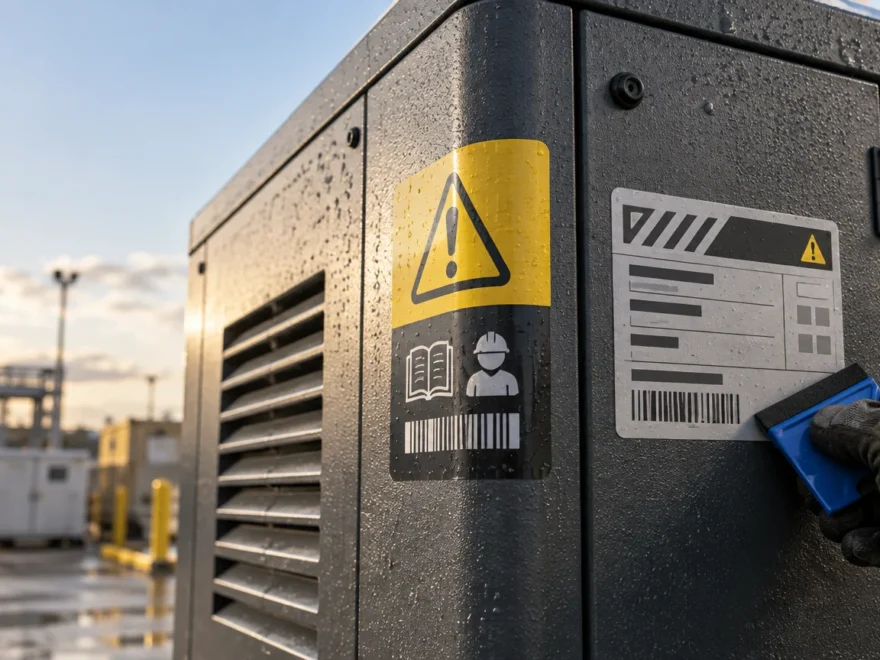
Consider a generator with a textured powder-coated steel enclosure. It needs a large operating-instruction graphic on a gently curved door and a smaller serial-number label on a flat recessed panel.
For the instruction graphic, I would begin with conformable laminated vinyl and a permanent adhesive selected for the specific powder coat. The laminate should have documented UV, abrasion, water, and cleaner resistance suitable for the site. Rounded corners and placement away from door edges would reduce opportunities for lifting.
For the serial number, I would evaluate an industrial polyester/PET system because dimensional stability and long-term code readability are more important than conformability. I would not specify either construction for the full fleet until production-representative samples had been applied to the cleaned enclosure, allowed to develop their bond for the supplier-specified period, and checked after exposure to the site’s normal cleaning routine.
This example also shows why labels and stickers can overlap in materials while serving different operational roles. The distinction is explained further in the comparison of custom labels and custom stickers. A service label, such as the identification formats discussed for HVAC service stickers, may also need writable fields, date tracking, or replacement access that changes the preferred finish.
Installation checklist
- Identify the exact substrate, including the paint, powder coat, or plastic type when known.
- Choose a relatively flat location protected from direct impact, pooled water, seams, and high-pressure spray edges.
- Remove loose dirt, oil, wax, silicone, and cleaning residue with a method approved for both the substrate and label system.
- Let the surface dry fully and confirm that both the air and surface meet the manufacturer’s application-temperature requirement.
- Test a production-representative sample on the actual equipment, especially on textured coatings and low-surface-energy plastics.
- Apply the label with even pressure, working outward to avoid trapped air and incomplete adhesive contact.
- Allow the supplier-specified bond-development time before washing, weather exposure, or operation.
- Inspect the edges after initial service. Early lifting indicates that surface preparation, location, adhesive, or conformability needs correction.
What to put in the supplier request
A useful quote request should describe the job rather than asking for the “most durable sticker.” Provide the substrate, texture, curvature, label dimensions, installation temperature, exposure orientation, expected service life, and whether the content is branding, instructions, a warning, a barcode, or regulated information. List direct sun, rain, snow, salt air, standing water, abrasion, fuels, oils, and every routine cleaner.
Ask for the technical data sheets for the face film, adhesive, print process, and laminate. Request the conditions behind durability claims and written confirmation of any chemical, pressure-wash, immersion, or low-temperature requirement. Safety, hazard, rating-plate, and compliance labels may have standards beyond ordinary material durability, so verify those obligations separately.
Final recommendation
Start with laminated permanent vinyl for general outdoor graphics on smooth or mildly curved equipment. Choose a documented industrial polyester/PET system for flatter serial, asset, barcode, warning, or rating labels when long-term stability and resistance are central requirements. Treat BOPP, polypropylene, paper, and any other material as product-specific options rather than assuming performance from the material name.
Before committing to volume, send the supplier a complete exposure and substrate description and test the proposed construction on the actual equipment. The best outdoor label is not the one with the largest durability number; it is the face film, adhesive, print, and laminate system whose published conditions and on-surface performance match the real job.